Monday, May 8, 2017

Free Complete SF short story - "Justice", from my Mindscapes collection

This is the shortest short story from my Mindscapes collection. Unlike most of my short stories from my current and previous collections, this was written in a single sitting in less than an hour. Aside from the basic idea of a trial and of the crime committed, I had no preconceived notion of where the story would take me. I always compose at the keyboard without outlining or preliminary notes with but a kernel of an idea that is developed as I write--for my fiction and poetry at least that is my process. The non-fiction requires much research and planning--but the fiction and poetry generally flows as it flows. I wish I had more time to devote to both. Someday . . . 

_______________________________________________________


JUSTICE

(C) 2011, 2017 Victor D. Lopez. All rights reserved.


Time: The all too near future
Place: A courtroom
Setting: Final sentencing of a prisoner convicted of the last remaining capital offense on the books of a kinder, gentler, fairer world in which equality is no longer a mere aspiration.
_____________________________

The prisoner stared impassively into the camera. The bright lights causing beads of sweat to form above his eyes and forcing him to squint, his perspiration-soaked thinning hair flattened unflatteringly against his forehead. No sound could be heard other than the faint hum of the air conditioning whose airflow was directed from the high ceiling above the high seats of the three judge panel, towards the three judges, keeping their immediate area comfortably cool. The camera trained on them remained a respectful distance away, and no harsh lights illuminated their somber countenances.
All three judges stared at the camera showing no emotion, their hands folded in front of them on the surface of their capacious bench on top of three equal stacks of paper placed before them. Everywhere on earth citizens watched the unfolding drama over the neural net that provided a fully immersive experience indistinguishable from reality, effectively placing every citizen on the planet in the courtroom as the Chief Judge began to speak in a deep, resonant, clear voice.
“The evidence against you has been examined. This tribunal finds you guilty of the charges against you by a unanimous vote. Have you anything to say before we pass sentence?”
The camera cuts back to the prisoner. The lights brighten around him and the heat rises perceptibly, adding fresh fuel to the trickle of sweat flowing down his flushed face, causing a bead of sweat to form at the end of his nose that he is unable to swat away because his wrists are restrained by metal bands at the armrests of his metal chair, outside the viewing range of the camera’s tight zoom on his face.
“I am guilty of no crime,” the prisoner protests in a low voice full of palpable weariness and resignation.
“You are guilty of the most heinous of crimes,” the Chief Judge contradicts, raising his voice and causing the prisoner to cringe. “That is not open to debate. This is your final chance to make what amends you may to those whom you have harmed through your selfish, deviant act. It will have no effect on this Court’s sentence.”
“But I have done nothing wrong,” the man emphatically protests again, as ribbons of perspiration roll down his neck and deepen the growing ring of dark sweat absorbed by his bright orange jumpsuit, leaving a collar of dark moisture around his neck.
“Silence!” the Chief Judge hisses through tight lips. “The record will show that the prisoner is unrepentant. This Court finds that he willfully, maliciously and without justification removed his neural connector with the purpose and effect of severing his connection to the neural nets. We further find that the motivating factor for this most egregious, malevolent and repugnant crime was the attempt to abandon the Common Consciousness and establish his individuality separate and apart from the Communal Mind. We further find that the subject is in full possession of his legal faculties and capable of understanding the criminal nature of his acts, and, perhaps most tragically, that he fails to see the enormity of his crime.” The Chief Justice faltered slightly, delivering the final words of the Court’s sentence with a slight tremor in his voice. After stopping a moment to compose himself as his learned colleagues looked on impassively, he continued. “It is, therefore, the judgment of this Court that you will forever remain disconnected from the nets from this day forward.”
Upon hearing the Judge’s words the prisoner’s eyes opened wider, attempting to digest their import. Could it be? Might he finally be allowed the what he believed to be his unalienable right to be an individual for the first time in his life? The opportunity to live in a world in which he could have original thoughts, genuine emotions, privacy and the opportunity to be different from everyone else? The joy he felt nearly made him faint with relief and unbridled joy, allowing him for the first time in his life the possibility of hope as tears welled in his eyes.
He found he could not speak, could not express even the simple words “thank you” to the Court. It was as though he were emerging from a life-long nightmare, as if. . .
“The prisoner’s IP address, 999.999.999.999, shall be erased from the Nets,” the Judge continued as the prisoner’s tears now flowed freely. “His existence shall be forever stricken from the Collective Consciousness lest it germinate there and once again grow sedition in our midst.” The prisoner wept openly now while smiling broadly.
“The death sentence for this most heinous of crimes is hereby commuted so that the prisoner may be allowed the individuality he craves for the rest of his natural life, devoid of the comfort of our collective humanity or the distracting influences of life.”
The Chief Judge then paused and took a deep breath, as the prisoner shuddered with relief. He then continued in a slow, resonant voice. “It is further ordered by this Court that the prisoner shall have his eyes, eardrums, tongue and olfactory organs surgically removed that he may not taste, see, hear, or speak with any other human being for the rest of his natural life. Thereafter, he is remanded to a hospital where he shall be restrained to a bed and tended to by robotic life support aids that he may be denied the comfort of feeling another human beings warm touch upon his skin. The sentence of this Court shall be carried out immediately and shall be witnessed by all the citizens of Earth as partial reparation for this most heinous of crimes against humanity.”
The prisoner’s screams lasted only a few moments as an anesthetic was administered and the cameras were re-arranged in preparation for justice to be carried out.

_________________

Note: You can hear my reading of this short story in a simple Youtube book trailer by clicking here.

Thursday, May 4, 2017

In a World Where Anyone Can Publish a Book Inexpensively, Why Does Your College Textbook Still Cost $200?

[Reprinted from one of my victordlopez.wordpress.com blog in 2013 -- Alas the issue remains unchanged]
Despite legislation at the federal level and in a growing number of states aimed at lowering the high cost of college textbooks, costs remain largely unaffected and students are still paying about $1,000 per year on average for their textbooks. Before continuing, I need to note that the reasons for the high cost of textbooks are numerous and fixing the problem is complicated for reasons that I will not delve into here. (For a thorough discussion of the issue, see my article “Legislating Relief for the High Cost of College Textbooks: a Brief Analysis of the Current Law and its Implication for Students, Faculty and the Publishing Industry” Journal of Legal Studies in Business, Vol. 15 (2009)). Rather, I will concentrate on what I consider to be the main factor: the marketing-driven push-model  of textbook distribution that dominates the industry today.
As the author of five law-related college textbooks who has been an academic for almost all of his professional career, this is an industry I have grown to know well. Common misconceptions to the contrary notwithstanding, neither publishers nor textbook authors are profiteering at the expense of students as most of the revenue from textbooks goes to expenses for their creation and distribution (including retailers’ profits). The care and feeding of the masses of marketing reps required to push textbooks on faculty through constant contact that includes periodic office visits to college faculty to keep them abreast of new features, upcoming revisions, and new textbooks in their fields of interest is massively expensive. (And frankly more than a little annoying to those of us who do not welcome those frequent, uninvited intrusions into our office hours.)
The textbook marketing model is very similar to the way life insurance is marketed–especially the really profitable type–whole life and universal life–where one-on-one, in-person marketing is the rule. (Although I sincerely doubt the sales reps rake in the 55% commissions on first-year premiums that insurance salespeople have traditionally made on the sale of whole-life life insurance from the major companies.)
Sales reps have become incredibly adept at the care and feeding of the university faculty that they depend upon to adopt their books. As a faculty member, you need only ask and you shall receive large numbers of expensive textbooks for review and as desk copies once a title is adopted. This is just part of the cost of doing business. Some publishers go out of their way to involve faculty members at schools with large prospective or current adoptions in ongoing reviews of their current or upcoming titles for which faculty receive normally a small honorarium of $100 or so. Others are more aggressive and sponsor junkets to popular destinations like Las Vegas for “training sessions” on the use of their products to faculty members at institutions with large textbook adoptions. This particular practice was targeted by recent federal legislation as well as legislation in some states aimed at reducing the cost of textbooks, but it has not yet been completely eradicated. And faculty who are busy with their class preparation duties, their research agendas and their university and departmental service loads are usually only too happy to look only at the titles suggested/pushed by the sales representatives of the handful remaining major textbook publishers.
The result is that most college faculty–including those who are truly interested in lowering the burden of the high cost of textbooks for their students–most often find themselves choosing among very expensive textbooks from at most two or three publishers happily provided for them by sales representatives who highlight the competing features and demonstrate the latest and greatest software, web-based features and video ancillaries intended to entice faculty to adopt their titles–and sometimes specifically intended to lock them in to the titles by offering proprietary software for homework management, grade keeping, and online classroom supplementation that is available only as long as the faculty member keeps adopting the publisher’s titles. Other viable options exist, but the vast  majority of faculty are not aware of them as there are no armies of solicitous salespeople pushing these on them on a constant basis.
Lest I be misunderstood, I genuinely like the publishers’ representatives with whom I deal on a regular basis (like it or not). They are helpful, competent, and they make my life easier when I am actually looking to change textbooks in the classes I teach. They are very good at doing their job. Unfortunately, doing their job requires the cost of textbooks to remain as high as it is in no small part because of the inherent expense of marketing textbooks under the traditional model.
Alternatives do exist today, but they cannot thrive under the shadow of the massive marketing forces marshaled by the traditional publishers. I’ll offer my own textbooks as a limited case study because I think they help prove my point. My first textbook, Business Law: an Introduction, was published in 1992 (with a 1993 copyright) by Irwin/Mirror Press. When Irwin was acquired by McGraw-Hill, the book was published by the new imprint for a number of years, even though it directly competed with one of its well-established titles, no doubt in part because of  loyal adopters who simply refused to switch to the new titles pushed by the new sales reps. The book was adopted by more than 100 colleges in 37 states in the three years that it was actively marketed by Irwin/Mirror Press. It did relatively well and developed a loyal following. This year, a new updated and expanded version of the book was released by my new publisher, Textbook Media (http://www.textbookmedia.com). My new publisher markets its textbooks in a very different manner through direct mail and perhaps some email marketing. Despite the fact that the book is better than the original and its soft-cover version sells for about one-fourth the price of the original hard cover retail price in today’s dollars (and is also available for as little as $9.95 in iPhone, online versions eBook versions), adopters are not beating a path to my publisher’s door for one very simple reason: the vast majority of past adopters and prospective new adopters have no idea that the book is once again available in print. The exact same thing is true of my “Business Law and the Legal Environment of Business 2e” released last year which is very slowly finding its market. A $200 business law book can support armies of sales people to push it; a $35 book simply cannot. That price point is dependent upon word of mouth and a limited direct mail campaign that cannot compete with the constant, direct, one-on-one marketing that the few remaining textbook publishing houses continue to employ to market their very expensive titles.
If we really want less expensive college textbooks, we all have to be more open to looking at non traditional sources, be they open textbooks where available, or textbooks from non-traditional publishers. The advent of inexpensive sources for self-publishing textbooks should also be explored, and universities and accrediting agencies need to be more open to the value that these sources can represent not only in terms of cheaper, more accessible textbooks for students but just as importantly a less restricted and more open avenue for content experts to share their expertise unbridled from the constraints of what will meet the norms of the traditional publishers (read: must not compete with current leading titles by that publisher and must provide the potential for very significant new sales to justify the development costs and risk of a new textbook launch). A faculty member may not be willing to spend three to five years to research, write, and revise a 45 chapter textbook, but 45 content experts from various universities would be much more likely to sign on to write one or more chapters in a collaborative venture. No publisher will coordinate this; it is up to us, the faculty, to do so. But universities and the government (both state and federal) could help by providing seed money, research grants or resources to both facilitate and promote such projects.
And students should also get involved in the process. Faculty select books, but that does not mean that students cannot make their concerns known about their cost known to their professors and the administrations of the colleges and universities they attend.
Finally, we need to recognize that low price alone is never a good measure of good value, let alone of quality. But neither is high price. As a faculty member, administrator or student, you can help lower the overall costs of college textbooks by focusing on the issue and making sure that your voice is heard. And as a faculty member or student, if you find a good product at a low-cost, make sure that others know about it. Publicize sites that offer new and used textbooks at the lowest cost; let others know if you find a good textbook exchange program for used books at your university so that it can be duplicated elsewhere; insist that your university provide you with a complete list of textbooks for all of your classes with enough lead time so that you can find the lowest cost options, new and used, on your own. And ask your professors when a new edition of a book comes out whether you can still use the old edition. Sometimes new editions contain only cosmetic changes–your professor will know if that is the case, and being able to use a prior edition of a book can save you a lot of money. But be careful: old editions are useless if a professor won’t allow you to use it–or if it contains dated, incorrect information. With textbooks as will all products, be a good consumer. You will be happier–and wealthier (or at least less poor)–for it, and it is a lesson that translates well to life and work in general.
Advertisements
Occasionally, some of your visitors may see an advertisement here
You can hide these ads completely by upgrading to one of our paid plans.
Filed under High Cost of College Textbooks

Leave a Reply

FREE Complete SF short story - The riddle of the Sphix: Solved

Complete SF Short Story from My Mindscapes Collection -- The Riddle of the Sphinx: Solved


The Riddle of the Sphinx: Solved
(C) 2014, 2017 Victor D. Lopez


The midday sun blazed in blinding glory directly over the Great Sphinx of Giza as Dr. Zahi Hawass, the famous Egyptologist whose love of Egyptian antiquity seems rivaled only by his love of the camera, faced the score of reporters with his well worn Indiana Jones hat and best cat-who-swallowed-the-canary-smile.
“Ladies and gentlemen, welcome. This is a great day for Egypt and the world,” he began with an enthusiastic smile and eyes sparkling like a sleepy child’s on Christmas morning. “Our efforts over the past year to excavate the recently found chamber under the right paw of the Sphinx is complete and we are ready to reveal its content for the first time. Please, come with me that we may share this moment together.”
Without further ado and in an uncharacteristically brief fashion, Dr. Hawass turned to his left, gesturing for the cameras to follow. As he walked, he continued, turning to the cameras and beaming contentedly. “We have uncovered a portal but have not yet broken the seal as we wish to share this moment with the world.”
“Zahi,” a reporter following closely to his right called out, “Can you tell us what you expect to find?” The Egyptologist stopped and turned to the reporter, with a patient, avuncular smile, and stopped, facing the cameras directly.
“I have no idea, but I expect it will be wonderful things.” He then turned and took several steps before once again stopping and turning to the camera. “You will see that there are no artifacts in the small antechamber we have uncovered, nor any artwork or extensive writing. There is, in fact, no traditional writing of any kind but for a line of undecipherable writing above a sealed doorway that is unlike anything that has been uncovered in the past.”
“You mean the writing is illegible?” the reporter interrupted.
“No,” Dr. Hawass replied, dabbing at his damp forehead with a large, white handkerchief.” “The writing is quite legible but is unlike any writing in the ancient or modern world. There are no glyphs, but previously unseen symbols over the doorway. The writing is not painted but etched onto the stone and glows quite visibly even in low light. I expect it will take us quite some time to decipher its meaning and the means utilized to achieve the bright glow, though we suspect it is some type of radioactive material similar to that used in instruments and watches in the recent past, though no trace of radiation has been picked up by our instruments.” He then resumed walking again towards the excavation, still some fifty feet away. “It is all part of the mystery, and it augers well for whatever archeological treasures may be secreted beyond the sealed wall, don’t you think?” His statement ended right on cue at the foot of the vertical tunnel that resembled more a well than the traditional entrance to a burial chamber.
“You must be careful descending the wooden ladder. There is only room for a few people down there as the antechamber is only approximately two meters by two meters and we already have two workmen down there ready to breach the sealed door. I can only take a camera operator down with me and will be happy to hold an extensive news conference later, once what lies beyond the seal is uncovered.”
Dismissing the numerous questions shot at him by members of the media present with a wave of the hand, he pointed to the closest Egyptian camera operator and said “You can accompany me. Careful, though. The workmen will steady the ladder below, but it is a long way down and the ladder will be unsteady.” He then stepped onto the ladder protruding above the meter-wide circular hole with the camera operator first filming his descent, and then following carefully, holding onto the ladder with his left hand as he balanced his the light but awkward camera on his shoulder harness with his right hand, filming nothing but his handhold on the ladder as he descended, not wanting to break the suspense.
Approximately three stories down, he finally hit solid ground, finding a chamber that appeared dug out of bedrock, with perfectly smooth walls everywhere but for the circular hole on the ceiling through which they had descended. The cameraman immediately swept his camera around the tiny room panning back to the limits of his camera’s wide angle view. Two workmen could be seen to each side of a wall directly opposite the ladder, covered in sweat to which clung rock granules and dust from their intense chiseling into the rock. The cameraman focused on the recessed symbols that arched above the perfect outlines of a rectangular door approximately a meter in width and two meters in height.
“Keep the camera on the writing,” the Egyptologist commanded and wait to be amazed.” He then turned off the intense halogen lights lights by pressing a switch on the line leading to the dual work lights that had brightly illuminated the small room, and the symbols came alive with a blood-red glow from within the carved stone. The symbols themselves were reminiscent of geometric figures and mathematical symbols, but were neither glyphs nor words in an unknown alphabet but a sort of combination of the two that was disorienting to the mind.
“We are about to begin. Please wear this dust mask,” Dr. Hawass told the cameraman, handing him a surgeon’s mask and donning one himself.  As he did so, he nodded to the workmen and signaled them to begin again as they sported their own dust-stained masks, and began chiseling at the rock in unison.
The simple hammer and chisel sounds in the small chamber was loud enough to force a twitch from the cameraman with each strike of the hammer. The workmen continued the jarring hammering to the center of the door which had no visible means of opening from this side of the chamber and, apparently, had not yielded to prior efforts at pushing, prodding or otherwise forcing it open. The fit of the door was so perfect as to leave only a hairline crack to distinguish the outline of where the door met the rest of the wall on polished rock that was incredibly smooth and free of imperfections.
Five minutes later, as the camera captured the faint swirling dust produced by the rhythmic strikes of hammer on steel chisels, the ancient stone gave up its last efforts at resistance, leaving a small hole the size of a sharpened chisel end on the stone which had yielded a concave depression several inches deep as a result of the repeated blows with hammers on chisels. An instant after the chisel had broken through, a bolt of plasma flashed through with the intensity at the center of the sun, filling the chamber and shooting up through the well-like opening to the outside, instantaneously vaporizing the still smiling Egyptologist, the cameraman, and the chisel-wielding workmen continuing upwards through the circular opening to the surface like a coronal emission radiating outward beyond the orbit of Mars. Blackest shadows followed, flowing outwards like a billion bats exploding from a cave in which dynamite had been detonated, evil personified shrieking outward freed from the restrictive seal placed by the protectors of what would subsequently become a primordial cradle of civilization.
The carved letters above the breached portal left by the victors of a galactic war whose final battle was fought on Sol millennia ago, and the remnants of whose vanquished hoards, forced to march through a portal to oblivion hidden below ground in an insignificant, life sustaining planet. The portal was then sealed and a guardian erected to mark the spot—using local materials and a magnificent predator from this planet to serve as a warning to the locals to stay away from this site marked by the gods.
With the passage of time and the rise of arrogant, foolish men who feared nothing but oblivion, the glorious lion’s head and flowing mane were ordered to be defaced and carved into the likeness of Khufu whose megalomania could not be satisfied by building the largest monument to himself that the world has ever known by way of the Great Pyramid at Giza. The result would become the iconic figure that would spawn mysterious controversies among historians and Egyptologists in the modern era with its too-small head in proportion to the lion’s body, the unavoidable result of having to fit a human face and headdress within the features of the original perfectly proportioned lion’s head. In time, Khufu’s face would itself be defaced by having its nose and beard chiseled away as clearly evidenced by the chisel scars left behind by the ancient defacers of the defacer. Whether the deed was done as some argue as an act of vengeance by another pharaoh, by religious zealots attempting to eradicate a blasphemous idol, or for some other reason, it matters little.

With the original warning unheeded, this now lonely symbol stands as a pointless monument to the boundless foolishness of a now dead race which loosed once more upon an unsuspecting galaxy the unspeakable evil that had been conquered at great cost before the ascent of homo sapiens, a race which having learned nearly nothing since climbing down from the trees in its infancy ignored a blazing warning in a forgotten tongue above a portal it blindly breached. The words originally written there would much later be echoed by Dante, inspired by the residual record of that prehistoric struggle between good and evil and which in the original tongue, as in its later Latin version, could be translated as “Abandon all hope all ye who enter.”

(C) 2014, 2017 Victor D. Lopez, All rights reserved 

Monday, May 1, 2017

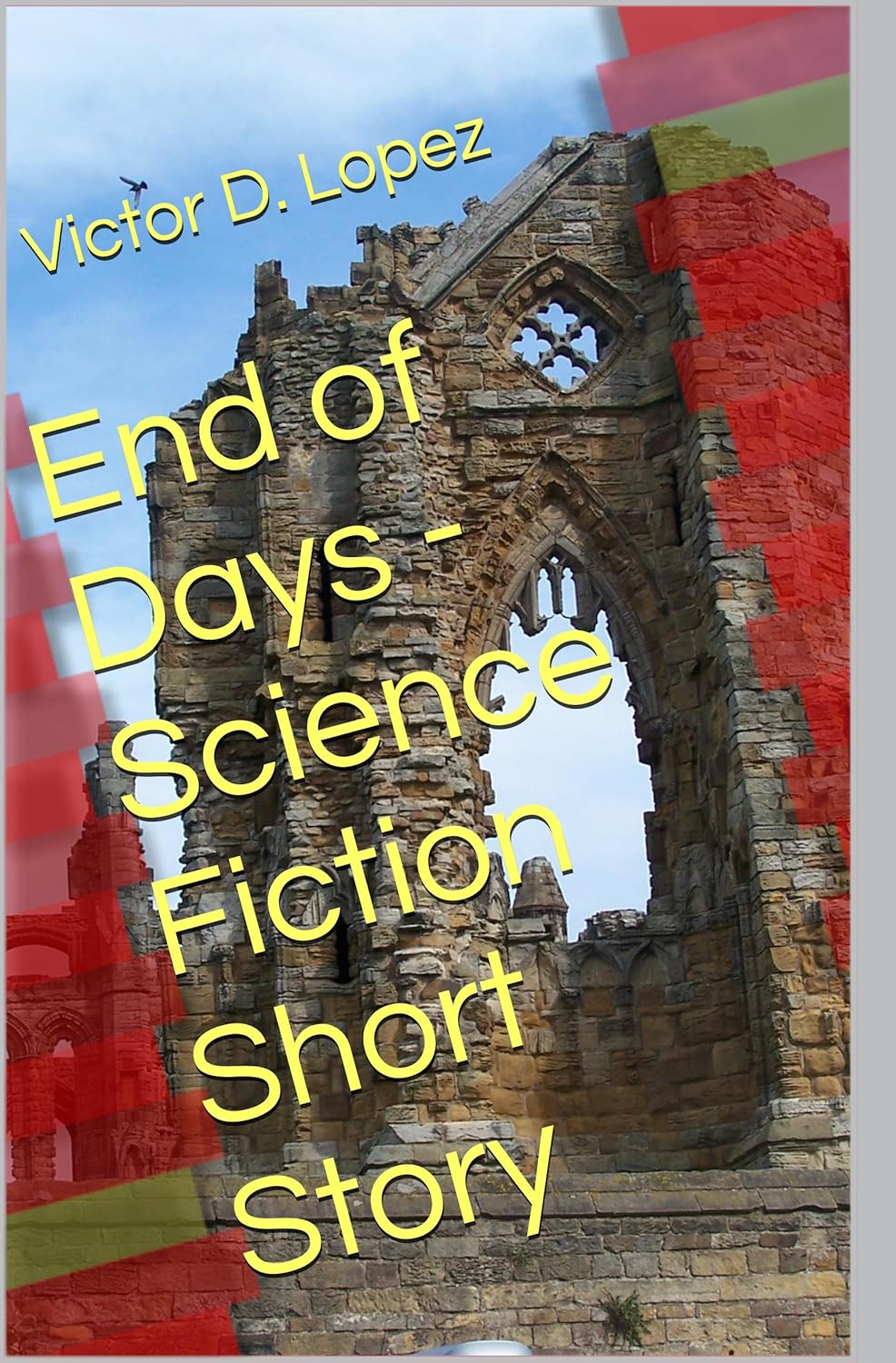
End of Days -- New SF short story giveaway for May

Please click on the following link to enter my second May science fiction short story giveaway for one of ten short stories from my Mindscapes short story collection:

https://giveaway.amazon.com/p/a30ed374fb80f001.

I am reprinting an excerpt from this short story below where you will also find links to the Amazon version of the book and also the Mindscapes collection. You can click on the Mindscapes cover for a link to the Amazon book's page where a preview of "Eternal Quest" is also available by clicking on the "Look Inside" feature. Thank you for your interest in my fiction! (Information about my current publications is also available below following the short story excerpt.)

________________


End of Days (Preview)


Victor D. López
Copyright Victor D. López 2014

God spoke to me last night. No, I am not schizophrenic or a Jesus freak. Nor am I a conspiracy theorist (well, except for JFK’s assassination, of course--unless the principles of quantum mechanics somehow apply to bullets fired from book depositories with inhuman rapidity to perform a dance macabre through the bodies of governors before striking their intended target), but I know precisely the series of events that will result in the end of the world and will eventually give birth to a new universe. It came to me in a dream. No, really, it did.
It all started pretty much like a bad Hollywood disaster flick (sorry, I know that’s redundant) with well funded mad scientists doing what comes natural in fiction as well as in fact. “Build us a big Hadron Supercollider, and we’ll find the elusive Higgs boson God particle. Maybe we’ll even come up with a unified theory that incorporates the pesky behavior of subatomic particles and allows us to demystify quantum mechanics once and for all.” It turns out, not surprising to anyone, other than scientists of course, that a little knowledge is a dangerous thing, and that allowing children to play unsupervised in a chemistry lab or with a super-duper, neat-o particle accelerator is not such a good thing after all. Who’d have thunk it?
The first hint that something was just a bit off-kilter came in the form of assurances by project scientists delivered with the smug expressions and thinly veiled contempt with which they usually approach any communication with the unwashed masses, that yes, miniature black holes could probably be created by subatomic particles accelerated at nearly light speed through a 17-mile circular particle accelerator and forced to collide in a massive release of energy, but such black holes would quickly dissipate. “No,” they smiled complacently, “there is absolutely no danger in these experiments.”
The second hint of a problem (and by hint I mean claxons going off, red lights flashing, and Robby the Robot’s accordion arms waving wildly while proclaiming “danger, Will Robinson!”) came when the Hadron Supercollider suffered some unspecified problems that caused it to be shut down for months on end after its first full-scale test. When the 17-mile supercollider was once again brought back on line, headlines proclaimed the countdown would begin again for the end of the world. Smile, snicker, hah-hah. What was not reported was the actual reason for the shutdown, since no one, including the geniuses running the experiments, knew the real cause: a miniature black hole that did not quickly dissipate in the lab as expected and caused a nearly catastrophic shutdown as it drilled an invisible hole a few molecules wide, eagerly sucking up anything that crossed its tiny event horizon, as it accelerated slowly but inexorably downward, worming its way through the containment chamber, rapidly vacuuming vital bits of the temperamental equipment on its way to the center of the earth.
Not to worry, though, it is still relatively small despite its voracious, unquenchable appetite, though it is exponentially increasing its mass as it swings like a pendulum through the earth’s core and beyond it in decreasing arcs that will eventually settle it at the earth’s core. It will be many months and perhaps years before we begin to feel the cataclysmic seismic effects of its inexorable violation of the earth’s core, and longer still before the entire planet and every living thing in it is sucked into its vortex, followed thereafter by the moon, and then the outer planets as the growing black hole continues its feeding frenzy, eventually consuming the entire solar system and Sol itself.
But that would be many years, perhaps millennia, in the future given the diminutive size of the black hole at present. And scientists still believe that the equipment failure was unrelated to its actual cause since the unreported black hole the initial full-scale test produced dissipated soon after its formation according to their classified reports. Therefore, the supercollider was repaired, and billions or Euros later, the scientists have their plaything once more and science is free to continue its happy march towards oblivion. If it ended here, we’d have little to worry about in the short term, other than perhaps ever-increasing seismic activity. Even the hungriest little black hole needs a great deal of time to ingest a planet from the inside out, and if later laboratory-created black holes don’t ingest other vital pieces of sensitive equipment on their way to joining their older brother down the rabbit hole in their inexorable journey to swallow our blue planet, we’d probably kill off our species through war, pestilence, famine or other forms of humanity’s endless capacity for galloping stupidity long before daddy’s and mommy’s little darlings consumed the world.
If my prescient dream had ended there, I’d shake it off with a smile and go about my day without another thought, compartmentalizing the certain knowledge of future doom in the nether regions of my mind, right next to the knowledge of the unsustainability of our ballooning federal and state deficits and the possibility of an asteroid hit that would once again eradicate most plant and animal life on this planet.
Unfortunately, scientists are not the only ones who like to play God. They are just more tragic and contemptible in their efforts at doing so because they should know better. They are like amoebas attempting to extrapolate the secrets of the universe by examining in minutest detail the drop of fetid swamp water atop a floating leaf that they inhabit. In a very real sense, scientists are among the smartest amoebas, all hail their boundless wisdom! But others like to play in the hedonistic God sandbox, too. And here is where my prescient dream grows infinitely darker.
It so happens that terrorists pay attention to science. Science, after all, brought us TNT, the A-bomb, the H-bomb, weaponized anthrax and lots of other cool goodies that are wonderful additions to the terrorists’ toolkits. As it happens, one particularly well funded, well connected group in the Middle East thinks it a grand idea to blow Israel off the face of the earth before that even better funded, and better connected state has the chance to do the same to them or to their proxy states. They have acquired a gaggle of disaffected, under-employed Russian physicists and funded them generously to come up with “outside-the-box” ideas for a doomsday device on the cheap. They did not have 17-mile supercolliders to play with, and Jihadist physicists are a rare breed. But not to worry, they had something better: money, lots of it, and the ability to entice scientists who view themselves above pedantic, bourgeois notions of ethics and for whom science is the only religion.
Undaunted by any notions of right and wrong and guided by the simple principle that “if it can be done, it must be done,” these brilliant men and women soon developed a working experiment that presented an elegant solution that their benefactors immediately approved.
Their plan was exquisitely simple and required very little by way of resources beyond two suitcase nukes that could be easily obtained either from Russia (cheap, old-world loose nukes listed simply as “missing” from the former Soviet inventory), or spanking new, state-of-the-art but untried ones from the secret Pakistani stash. They opted for the Russian suitcase nukes, in part because they did not want a trusted ally compromised in the event that their experiment failed to attain the desired end.
***** END OF PREVIEW ****

NOTE: The short story collection is available on paperback, audiobook and eBook versions from Amazon, Audible and most book sellers. The short story is also available in various eBook versions, including a Kindle version from Amazon and other book sellers as well. Both are also available to libraries at very low cost. If you like the preview and think you and others may enjoy reading the whole story or short story collection, won't you consider recommending them to your local library? All are available for library purchase, including through OverDrive for libraries that use the popular Live-brary platform.  Thank you!


View my current individual short stories and and Mindscapes collection along with most of my current books at my Amazon Author's Page by clicking here.


Available at Amazon, iBooks, Barnes & Noble, 
Smashwords, and other retailers
I am a tenured Professor of Legal Studies in Business at Hofstra University’s Frank G. Zarb School of Business. I've earned a Juris Doctor degree from St. John’s University School of Law and a B.A. from Queens College, C.U.N.Y. (English Honors Program – Writing) and am a member of the New York State Bar, New York State Bar Association, the Academy of Legal Studies in Business (ALSB) and the North East Academy of Legal Studies in Business (NEALSB). I've been an academic for more than 25 years and, prior to joining the Hofstra University faculty, served as a tenured Professor of Business, as Dean of Business and Business Information Technologies, and as Academic Dean in urban, suburban and rural public and private academic institutions.
My published books include several textbooks and trade books and I've written poetry and fiction throughout most of my life, some of which has been published in anthologies and literary magazines in addition to self-published collections.
Book of Dreams 2ndEdition: Science Fiction and Speculative Fiction Short Stories (Printed through CreateSpace and Kindle Direct, 2012)
Of Pain and Ecstasy: Collected Poems (Printed through Kindle Book Publishing and CreateSpace, Summer 2011)
Intellectual Property Law: A Practical Guide to Copyrights, Patents, Trademarks and TradeSecrets (Printed through Kindle Book Publishing and CreateSpace, Summer 2011)
Business Law: An Introduction 2e, Textbook Media, 2011. (text, test bank, and instructor’s manual) Available at http://www.textbookmedia.com
Business Law and the Legal Environment of Business 2eTextbook Media 2010. (text, test bank, and instructor’s manual) Available at http://www.textbookmedia.com
Free and Low Cost Software for the PC, McFarland & Company 2000. [out of print]
Legal Environment of Business, Prentice Hall 1997. (text, test bank and instructor’s resource manual) [out of print]
 Case and Resource Material for the Legal Environment of Business, Prentice Hall 1997.
Business Law: An Introduction, Richard D. Irwin/Mirror Press 1993. (text, test bank and instructor’s resource manual) [out of print]
Free and User Supported Software for the IBM PC: A Resource Guide for Libraries and Individualshttp://www.amazon.com/Victor-D.-L%C3%B3pez/e/B001KMII74, McFarland & Company 1990. (coauthored with Kenneth J. Ansley) [out of print]
Author's Web Page: http://www.victordlopez.comhttp://www.victordlopez.com